Friday, February 7, 2014

Four Versions of the Ten Commandments: The Third Commandment


This is the third in a series of blogs that presents four versions of the Ten Commandments (based on Exodus 20). Each blog presents a commandment from the sources listed in chronological order below:

(1) Rabbinic Judaism (200 CE)
(2) Catholicism (325 CE)
(3) Protestantism (16th century CE)
(4) Biblical Heritage Center (analysis completed in 2014 CE)

The Third Commandment

Rabbinic Judaism

You shall not take the name of the Lord your G-d in vain.

Catholicism

Remember the Sabbath day, to keep it holy. Six days you shall labor, and do all your work; but the seventh day is a Sabbath to the Lord your God; in it, you shall not do any work.

Protestantism

. You shall not take the name of the Lord your God in vain.

Biblical Heritage Center

You shall not bow down to graven images or serve them.

Don’t keep this information to yourself – share it with others. The next time someone says something about the Ten Commandments, be sure to ask which version.

CLICK HERE to read our blog on the First Commandment.
CLICK HERE to read our blog on the Second Commandment.

Shalom & Be Empowered!

Please let us know you like this blog by going to our Facebook page by clicking here and – “Like” it & “Sharing” it with others. 


Our work is completely funded by the gifts of individuals. If you find our work useful and valuable, take time to contribute by clicking here.  Your consideration is greatly appreciated.


Thursday, February 6, 2014

Four Versions of the Ten Commandments: The Second Commandment


This is the second in a series of blogs that presents four versions of the Ten Commandments (based on Exodus 20). Each blog presents a commandment from the sources listed in chronological order below:

(1) Rabbinic Judaism (200 CE)
(2) Catholicism (325 CE)
(3) Protestantism (16th century CE)
(4) Biblical Heritage Center (analysis completed in 2014 CE)

The Second Commandment

Rabbinic Judaism

. You shall have no other gods but me.

Catholicism

You shall not take the name of the Lord your God in vain.

Protestantism

. You shall not make unto you any graven images.

Biblical Heritage Center

You shall not make for yourself a graven image, or any likeness of anything that is in heaven above, or that is in the earth beneath, or that is in the water under the earth.

Don’t keep this information to yourself – share it with others. The next time someone says something about the Ten Commandments, be sure to ask which version.

CLICK HERE for to see the blog on the First Commandment.

Please post your comments on this blog or email them to me by clicking here.

Shalom & Be Empowered!

Please let us know you like this blog by going to our Facebook page by clicking here and – “Like” it & “Sharing” it with others. 


Our work is completely funded by the gifts of individuals. If you find our work useful and valuable, take time to contribute by clicking here.  Your consideration is greatly appreciated.


Wednesday, February 5, 2014

Four Versions of the Ten Commandments: The First Commandment

It is discussions about things that everyone thinks they know that often reveal some very interesting surprises. Discussions about the Ten Commandments often fit into that category.


 Depending on who is presenting the list of commandments, you may be surprised to learn that the commandments will differ. In this series I will present four versions of the Ten Commandments that are based on Exodus 20, the verses that are traditionally called ”The Ten Commandments.” The different versions are Jewish, Catholic, Protestant and ours (Biblical Heritage Center). I will present the different versions of each commandment in separate blogs, so you will have time to consider the differences.

Each blog will list the versions in a chronological order based on when the source came into existence or in our case, last week when we completed the analysis:

(1) Rabbinic Judaism (200 CE)
(2) Catholicism (325 CE)
(3) Protestantism (16th century CE)
(4) Biblical Heritage Center (analysis completed in 2014 CE)

The Book of Exodus is part of the Torah, which is the first section of the Jewish Scriptures. It existed long before Rabbinic Judaism, Catholicism, Protestantism or the Biblical Heritage Center came into being; just as Rabbinic Judaism existed before the others. At the end of this series I will provide an overview.

The First Commandment

Rabbinic Judaism

I am the Lord your G-d who brought you out of the land of Egypt.

Catholicism

I am the LORD your God, who brought you out of the land of Egypt, out of the house of bondage. You shall have no other gods before me. You shall not make for yourself a graven image, or any likeness of anything that is in heaven above, or that is in the earth beneath, or that is in the water under the earth; you shall not bow down to them or serve them.

Protestantism

You shall have no other gods but me.

Biblical Heritage Center

You shall not have other gods but me.

Please post your comments on this blog or emailthem to me by clicking here.

Shalom & Be Empowered!

Please let us know you like this blog by going to our Facebook page by clicking here and – “Like” it & “Sharing” it with others. 

Our work is completely funded by the gifts of individuals. If you find our work useful and valuable, take time to contribute by clicking here.  Your consideration is greatly appreciated.


Friday, January 24, 2014

Basic Tools for Studying the Hebrew Bible

I receive many inquiries asking about which Hebrew-English Interlinear Bible I would recommend. There are two interlinear Bibles that I have used in Bible studies and classes for many years:

(1) The Interlinear NIV Hebrew-English Old Testament by John R. Kohlenberger III 
(2) The Interlinear Bible: Hebrew-English (4 Volume Set) by Jay Patrick, Sr. Green

The text of an interlinear Bible looks like this:

(Remember, Hebrew is read from right to left ß     ß     ß)

As you can see, the Hebrew text is written on the upper line and an English translation for each word is found below each Hebrew word. Studying with an interlinear Bible is a step up from just using an English translation, but unless you know how to find the root words for each of the Hebrew words in the interlinear text and look up their meanings in a lexicon you are still dependent on the choices translators made and will not know the other options for translating the words were.

Being able to look up the root words in a lexicon requires another tool – an analytical lexicon. In order to use it, you need to memorize the Hebrew alphabet or use the BHC Hebrew-English Transliterator.

(If you haven’t downloaded and learned how to use our FREE Hebrew-English Transliterator CLICK HERE for Part 1 & CLICK HERE for Part 2. These are very short exercises that teach you how to use the BHC Hebrew-English Transliterator.)


Below is a picture of what you see in an analytical lexicon and how it identifies the root word:


As you can see, the Hebrew text is written on the upper line and an English translation for each word is found below each Hebrew word. Studying with an interlinear Bible is a step up from just using an English translation, but unless you know how to find the root words for each of the Hebrew words in the interlinear text and look up their meanings in a lexicon you are still dependent on the choices translators made and will not know the other options for translating the words were.

Being able to look up the root words in a lexicon requires another tool – an analytical lexicon. In order to use it, you need to memorize the Hebrew alphabet or use the BHC Hebrew-English Transliterator.

(If you haven’t downloaded and learned how to use our FREE Hebrew-English Transliterator CLICK HERE for Part 1 & CLICK HERE for Part 2. These are very short exercises that teach you how to use the BHC Hebrew-English Transliterator.)

Below is a picture of what you see in an analytical lexicon and how it identifies the root word:


The Hebrew analytical lexicon I recommend is -- The Analytical Hebrew and Chaldee Lexicon
by Benjamin Davidson

I also recommend that students use A Concise Hebrew and Aramaic Lexicon of the Old Testament by William Lee Holladay to find the meanings of root words. Most of the analytical lexicons were written over a century ago, long before the Dead Sea Scrolls and other important discoveries were made. Holladay’s lexicon includes the later information and is much more useful and relies less on theology. The BHC Hebrew-English Transliterator is also keyed to Holladay’s lexicon.

A comprehensive computer program that allows you to do in-depth Bible studies is BibleWorks 9. This a great computer program that includes a library of resources. I have been using it for many years. BibleWorks 9 is a large collection of software tools and database resources designed specifically to assist pastors, seminary students, professors and missionaries in their exegesis of the Biblical text. It contains more than 200 Bible translations in nearly 40 languages, 45 original language texts and morphology databases, 29 lexical-grammatical references, and a wealth of practical reference works. These include Greek and Hebrew sound files, Bible maps, Greek New Testament diagrams, Greek and Hebrew grammars, new transcriptions and image sets for seven of the most important Greek New Testament manuscripts, and the full CNTTS New Testament apparatus. 

For more information about the above Hebrew Bible Study Tools or to purchase them – CLICK HERE.


Thursday, January 23, 2014

Different Types of Biblical Love -- HESED & RAChAM

Today, I received an email with the following question:

In the Hebrew Bible, what is the difference between hesed and rahamim?

These are two very important biblical words that are translated by the same English words often, but they have very important differences.

(If you haven’t downloaded and learned how to use our FREE Hebrew-English Transliterator CLICK HERE for Part 1 & CLICK HERE for Part 2. These are very short exercises that teach you how to use the BHC Hebrew-English Transliterator. It will transform the way you study your Bible. The Hebrew Lexicon we use and recommend is A Concise Hebrew and Aramaic Lexicon of the Old Testament by William L. Holladay. For more information about it, or how to order your copy -- CLICK HERE.)


The first word we will examine is HESED.


The definition is found in A Concise Hebrew and Aramaic Lexicon of the Old Testament by William L. Holladay on page 111a entry # II:

1. obligation to the community in relation to relatives, friends, guests, master, and servants; loyalty; faithfulness.

2. In relationship of God to people or individuals, faithfulness, kindness, grace.

The second word is RAChAM (rahamim is the plural form).


Its definition is found on page 337b:

1. show love for

2. have compassion on

When a Hebrew speaker sees or hears this word, they understand its relationship to another Hebrew word that has the same root and is found written exactly as the above word – RAChAM. Its meaning is found below the definition above:

1. womb
I was discussing this with a rabbi many years ago and I haven’t forgotten what he said:

RAChAM means “to show love or compassion like a mother shows for her child.” It denotes a “motherly type of love.” This parental type of love is seen in Psalm 103:13 where RAChAM is used twice – “As a father has compassion on his children, so the Lord has compassion on those who fear him.”

On the other hand, HESED is “linked to a relationship based obligation” and denotes a “loyalty and faithfulness type of love.” This type of love is seen in Psalm 33:5 – “He loves (AHAV) righteousness and judgment: the earth is full of the loving-kindness (HESED) of the LORD.”

If you like this BHC Bible Study, please let me know by “Liking” BHC on Facebook by clicking here. It will only take a minute and doesn’t cost anything – but it really helps me to know that you benefited from my work. Also, please share it with others.


SHALOM & Be Empowered!


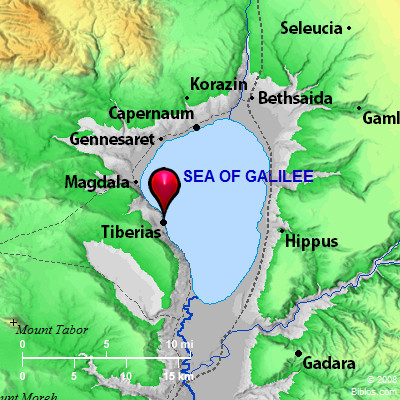
Sea of Chinnereth, Sea of Tiberias, Lake of Gennesaret, Sea of Galilee and Lake of Galilee

The names of places change – even in the Bible -- and unless you are aware of those changes you may not know that different names ion the Bible are references to the same place. A good example is a very well-known body of water in the Bible.

Sea of Chinnereth

In Numbers 34:11 & Joshua 13:27, YAHWEH and Moses called it the Sea of Chinnereth. A Canaanite fortified village called Chinnereth was located on northwestern shore of that body of water. It had been there long before the Israelites settled there. The body of water was named after the village.


Today that village is called Tell Kinneret.


Lake of Gennesaret
The name of the village above is also spelled Kinnereth and it gradually changed over the years to Genezareth, Genezar and Gennesaret.[i]

The Sea of Galilee

In Joshua 20:7 we read: “And they appointed Kedesh in Galilee in mount Naphtali, and Shechem in mount Ephraim, and Kirjatharba, which is Hebron, in the mountain of Judah.” Galilee was an area in the area given to the tribe of Naphtali. The name “Sea of Galilee” doesn’t appear in the Hebrew Bible. It appears that the body of water acquired the name Galilee from the name of the surrounding area after being known as the Sea of Chinnereth. In Matthew 4:18, it is called the Sea of Galilee.


Sea of Tiberias

The city of Tiberias was founded sometime around 20 CE by the Roman client king Herod Antipas, son of Herod the Great. The city was built as a spa and developed around 17 natural mineral hot springs and was populated mainly by Jews.  It was place with a growing spiritual and religious status, which exerted a strong influence on health practices associated with bathing in the natural springs.[ii]


Sea or Lake?

When we look up the definitions of “lake” and “sea” in an English dictionary we find the following:

● lake – a body of fresh or salt water of considerable size, surrounded by land.

● sea – the salt waters that cover the greater part of the earth's surface.

The Sea of Galilee is an inland body of fresh water 13 miles long x 8 miles wide x 150 feet deep. Based on the English definitions above, the Sea of Galilee is a lake. Of course, that means that the “Dead Sea” is one too.

The next time you find the Sea of Chinnereth, Sea of Tiberias, Lake of Gennesaret, Sea of Galilee or Lake of Galilee you will realize that they are all names of the same body of water.

If you like this BHC Bible Study, please let me know by “Liking” BHC on Facebook by clicking here. It will only take a minute and doesn’t cost anything – but it really helps me to know that you benefited from my work. Also, please share it with others.


SHALOM & Be Empowered!


Sunday, January 19, 2014

Is “In the Image of God” an Inaccurate Translation?


And God created mankind in His own image, in the image of God He created them; male and female He created them. (Genesis 1:27)

This is one of the most famous verses in the Bible because it contains one of the most powerful memes in the history of mankind – humans are created in the image of God.

Memetics, a very new discipline, is transforming the way we view information, its transmission and influence on human behavior. It has important implications for understanding the Bible and the religious institutions that base their authority upon it. The following will provide you with an overview of the meaning of “meme:”

(1) the unit of cultural heredity analogous to the gene
(2) the internal representation of knowledge
(3) the complex idea that forms itself into a distinct memorable unit
(4) it is spread by vehicles that are physical manifestations of the meme
(5) a unit of information in a mind whose existence influences events
(6) a unit of information that causes copies of itself to be created in other minds.[i]

Memes are idea complexes and meme vehicles are their tangible expressions.[ii] If we use the example of a computer, genes are like the hardware and memes are like the software.

The original meme in the above verse was written in Hebrew. If you haven’t downloaded and learned how to use our FREE Hebrew-English Transliterator CLICK HERE for Part 1 & CLICK HERE for Part 2. These are very short exercises that teach you how to use the BHC Hebrew-English Transliterator. It will transform the way you study your Bible. So, get your BHC Transliterator and use it as we examine the Hebrew word that was translated “in the image of” in Genesis 1:27 above:


In order to understand how to translate it, we must learn how Hebrew words are constructed.


Now let’s take another look at the Hebrew word above using this information:


In order to determine the meanings, we must look up the meanings of the prefix and the root word separately in our lexicon. The Hebrew Lexicon we use and recommend is A Concise Hebrew and Aramaic Lexicon of the Old Testament by William L. Holladay. For more information about it, or how to order your copy -- CLICK HERE.

Now let’s look at the prefix using the BHC Hebrew-English Transliteration:


It is letter #3 that is called “Vet.” It is a form of letter #2, Bet. A Vet is transliterated “V” and a Bet “B.” Look beneath the name “Bet” on the Transliterator and you will find “32,” which is the number of the page this letter first appears in the Holladay lexicon. In our studies, I refer to the location of words by page and column (a = left column; b = right column). The prefix above is found on page 32a where we find the following options for translating it:

1. in
2. among
3. as
4. within
5. on
6. on the
7. in
8. according to
9. into
10. by
11. N/A
12. (together) with
13. from
14. more than
15. with an; through (by)
16. for
17. N/A
18. because of, for the sake of
19. N/A
20. when

It is absolutely essential for you to understand that when you read any translation of the Bible you are only aware of the choice the translators chose from a number of other options. In other words, the choice made by the translators for the “Vet” prefix was “in,” but readers of their translation are completely unaware of the other nineteen (19) options they could have chosen. The more you learn to work with the Hebrew and Greek words of your Bible, the more you will realize exactly how often the theologies of the translators influence the choices they make. Anyway, glance over the above options for this prefix again and consider how different choices would have changed the translation.

Now let’s turn our attention to the root word:


It is found in Holladay’s on page 306b. There are two separate entries for this word -- I & II. I will use the transliteration of the root word TzELEM to indicate the two options:

I. TzELEM
1. statue
a. 2 Kings 11:18a – “And all the people of the land went to the temple of Baal, and tore it down. They thoroughly broke in pieces its altars and images . . .”
b. Numbers 33:52 – “then you shall drive out all the inhabitants of the land from before you, destroy all their engraved stones, destroy all their molded images, and demolish all their high places.”
2. image, model
a. 1 Samuel 6:5a – “Therefore you shall make images of your tumors and images of your rats that ravage the land, and you shall give glory to the God of Israel. . .”
b. Ezekiel 23:14 -- “But she increased her harlotry; she looked at men portrayed on the wall, images of Chaldeans portrayed in vermilion.”
3. image (Genesis 1:26a) – “God said, “Let Us make man in Our image . . .”

II. TzELEM
1. Shadow, something shadowy, form without substance.
a. Psalm 39:6 (7) – “Man is a mere phantom as he goes to and fro . . .”
b. Psalm 73:20 – “As a dream when one awakes, so when you arise, O Lord, you will despise them as fantasies.”

Traditionally, all translators that I am aware of chose option #1 for the translation for the prefix “in” and option #I “image” for the translation of the root word.

But, there is a factor that I believe translators failed to fully consider when choosing their options – context.

Context is defined as that which precedes and/or follows any part of a discourse and can throw light on the meaning.

There are no references in the context to the physical description of God. But there are two verses that provide information we need to make a more informed decision about which option to choose:

(1) Genesis 1:2b – “And the Spirit of God was hovering over the face of the waters.”

(2) Genesis 2:7 -- “And the Lord God formed man of the dust of the ground, and breathed into his nostrils the breath of life; and man became a living soul.”

Two different Hebrew words are used in the above verses for Spirit and breath, but they share the meaning of “form without substance.” They are the best description of God in the context before and after Genesis 1:27. Based on the linguistic principles that we call the BHC Linguistic Method, “Spirit” is the most contextually accurate option for the root word. When we use the same principles to determine the best option for the prefix, our choice is “with.” Now let’s use this information to update our translation of Genesis 1:27:

And God created mankind with His own Spirit, with the Spirit of God He created them; male and female He created them. (Genesis 1:27)

In many ancient cultures, their meme for the creation of humans transmitted the idea that humans are created to serve gods and goddesses, and are lower in value than animals.  The traditional meme from the verse above – humans are created in the image of God – produced a very different view about humans – they were created in God’s image. Humans are created a little lower than God, but above all other creatures.

I believe that our more contextually accurate translation of the meme will have an even more powerful impact – especially when people either look in the mirror at themselves or when they interact with others and see every human as a creature “with His Spirit” – male and female, regardless of race, tribe or religion.

Of course, every human also has an Earth-soul – and it affects the choices we make -- but we will have to discuss that in a future blog.

Consider the content of this study and the way I provide you with as much factual information as possible, so you can learn how to acquire and use new skills and tools that allow you to understand how the words that appear in your Bibles were chosen. I believe this prepares you much better than simply telling you what choices I would make. Being chained to one translation of the Bible keeps you from growing and maturing spiritually.

If you like this BHC Bible Study, please let me know by “Liking” BHC on Facebook by clicking here. It will only take a minute and doesn’t cost anything – but it really helps me to know that you benefited from my work. Please share it with others.

Help fund our work so we will be able to provide you with a much greater number of studies like this. Your financial support will help make it possible. Donate today and help make this possible -- CLICK HERE. We have the information in our databases, but need to be able to hire people to help us prepare and publish the information. Become a financial partner with BHC today.

SHALOM & Be Empowered!


[i] Virus of the Mind: The New Science of the Meme by Richard Brodie © 1996; Hays House, Inc., New York, NY; pp. 6-11.
[ii] Memes in Digital Culture by Limor Shifman © 2014 Massachusetts Institute of Technology; The MIT Press, Cambridge, MA; p. 38.